Alhamdulillah the first issue of Mum and Muslim magazine is launched. I am so delighted to see the magazine on line alhamdulillah. I am very grateful to all the sisters and brothers who worked very hard for the magazine. May Allah swt reward all! We have received very positive feedback alhamdulillah. Now the goal is to maintain the quality insha-Allah. I hope we will be able to deliver more through the next issue. There are so many things to learn. May Allah swt make it easy for us.
We already got a facebook group. Feel free to join and share your suggestion. We are looking for contributors including writers, photographers. Please do get in touch by emailing me at editor@mumandmuslim.com.
Our website also offers a forum for parents. Do join us there too. It is just the start. Insha-Allah we are working hard to improve the quality of the magazine. Our aim is to publish the magazine on the 1st Friday of every month insha-Allah. Keep us in your duas everyone!
Monday, 5 April 2010

Friday, 19 March 2010
Mum and Muslim e-magazine
Assalamu alaikum wa rahmatullahi wa barakatahu brothers and sisters,
Alhamdulillah I have been blogging quite irregularly :-( since 2006. Up until now, I haven’t said that much about myself so today I would like to say it bit about me and my work Insha-Allah. I was born in Pakistan, spent most of my childhood in various countries and finally settled (at least up until now) in the UK. I have done my graduation in Sociology which I enjoyed a lot alhamdulillah. I have been involved in Islamic society at university. Mashallah the sisterhood and brotherhood I have witnessed at university was really wonderful. I really miss my beautiful time at university :-( After graduation I have worked as a teacher at a private school. I had to teach Science and Maths at primary level, Physics at secondary level and Sociology at AS level which once again I thoroughly enjoyed alhamdulillah. I went to hajj in 2006 , for me that's the best thing I have ever done in my life Alhamdulilllah. It was a wonderful experiance I must say :-) I wish I can go again insha-Allah but hopefully with my whole family.
Alhamdulillah I am happily married since 2006, mother of two very young children. My son is 2 years old and my daughter is 11 months old. My husband is my best friend alhamdulillah .
While going through the difficult phase of pregnancy, I was very keen to gain as much knowledge as possible from the Qur’an and the Sunnah of our beloved prophet Muhammad (saw) about pregnancy and motherhood and any topic related to parenting. Some of the books I bought during that time proved really handy alhamdulillah. Hope to do reviews of them soon insha-Allah, so that other sisters and brothers can benefit too. Like lot of women, I am a big fan of magazines. During that time, all the magazines I came across did not offer any information based on our faith. I did find some of the Muslim magazines quite useful but I felt I needed something more and a Muslim parenting magazine is what I wanted most. Alhamdulillah last year I met a like minded sister who is also very passionate about starting a parenting magazine for Muslims insha-Allah. Alhamdulillah we also live quite close to each other. Is that a coincidence? Subhanallah! Allah swt always makes things easier for us :-) Insha-Allah we are hoping to launch our e-magazine by the end of this month. There are so many things to do before the launch. My home is our office for the time being. Mashallah several sisters have shown interest to help us. We all are very excited and looking forward to work together Insha-Allah! There are so many topics to write for. The categories are as follows:
Getting pregnant; Pregnancy & Birth; Baby; Toddlers +
Kids; Teenagers; Young adults;Lifestyle: which includes Health; Beauty; Fashion; Recipes; Hobbies;
News and events;
Education
Mummy diaries
Reviews: (Books, Products, TV programmes, Films, Restaurants etc)
Resources: The Quran; Sunnah; Duas; Baby names
Dads’ issues; Mums’ issues
Useful links
There are so many other issues to include insha-Allah. Feel free to share your suggestion insha-Allah.
Our community is growing mashallah and hopefully by 2020 most of it will consist of young Muslims. If we want to succeed in this life and in hereafter we need to bring up our children according to Allah’s way. To do that, we must educate ourselves with the proper knowledge and understanding of what Islam tells us about parenting. I hope through this magazine, we will be able to help each other to raise our children as better Muslims insha-Allah. We have also created a facebook group call Mum and Muslim Magazine. We hope that through the group we will be able to unite all the Muslims male and female, to work together for this noble cause. Do feel free to share your ideas and suggestions on this matter.
Mum and Muslim Magazine : Raising more than children, raising our Ummah !
Our Lord! Grant that our spouses and our offspring be a comfort to our eyes, and give us the grace to lead those who are conscious of You, ameen.
Wassalam, Umm Imran.
Thursday, 17 December 2009
The new Hijri year 1431

All praise to Allah swt, tomorrow is going to be the start of new Hijri year 1431 Insha-Allah. Most times due to ignorance, we Muslims tend to miss the start of the Islamic New Year and are unfortunately more aware of 31st December and tend to celebrate this ‘happy new year’ more seriously. Alhamdulillah our new generation of Muslims are trying to learn more about Islam and Insha-Allah very soon, we Muslims will be able to celebrate the new Hijri year with the proper understanding. We need to remind each other of the significance of Islamic year Insha-Allah.
The other day, I found a very beautiful supplication in Zaytuna Institute journal ‘Seasons’. This is a very beautiful dua which someone can do at the end of the Hijri year.
It was mentioned in the book, The Treasure of Success and Felicity in the Supplications that expand the chests (Kanzun-Najah was-Surur), that if a person reads the following supplication three times at the end of the year, the Devil will say, “ We tired ourselves with him all year, and he ruined all that we have done in one moment.”
“ In the name of Allah, the Compassionate, the Merciful and Allah swt bless our teacher Muhammad and his family and companions and grant them peace. O Allah , whatever actions I have committed this past year which have not pleased You, which I may have forgotten though You do not forget, while You are forbearing with me , though fully capable of punishing me, while You called me to relent and atone even after my audaciousness before You – O Allah, I surely seek Your forgiveness for that, so forgive me ! O Allah, as for my actions that have pleased You and for which recompense and forgiveness has been promised, please accept them from me. And do not dash my hopes in You, O Generous, O Most Merciful of the Merciful. And Allah, the Exalted, bless our Master Muhammad and his family and companions and grant them peace.” ( 3 times)
May Allah swt grant us a very blessed new Hijri year, ameen. May the next year be the year of seeking more knowledge of our beautiful faith and actions inspired by the knowledge acquired! May Allah swt accept our deeds and grant us Jannahtul Ferdous, ameen.
Tuesday, 8 December 2009
In loving memory of sis Umm Zakaria
Bismillahir Rahmanir Raheem

“I guess in all actuality it should be a reminder for me to take each day, minute, prayer as if it may be my last. We have to take the most out of our time, Allah has already written how much time we have left, and there is nothing we can do to change that. I am at complete peace with that.....”
This was the last post written by sis umm Zakaria before her death. Inna lillahe wwa inna ilaiher rajeuun. Yesterday for the first time, I came to know about her blog http://pinkhijab.blogspot.com/She started blogging to share her experiences with breast cancer from an Islamic perspective. When I started reading her blog, I couldn’t stop going through all the post she has written. Today I tried to finish the rest of the post without even realizing that this sister has already left us last month! I was shocked and felt so moved by her story. Although I have never met her, my eyes were full of tears. I couldn’t stop crying for this wonderful sister. How much strength and faith this sister had to face such a difficult situation with so much patience! Subhanallah !
Sis, you will always have a very special place in my heart. I know it’s too late to personally thank you for what you have done for all of us by sharing your experience with us but I make dua to Allah swt that may Allah swt reward you with the best, the jannatul ferdous. May Allah swt keep your children safe and happy and make them best of the Muslims, ameen. May Allah swt give your beloved family lots of strength and patience to endure your great loss. May Allah swt give us all the ability to act upon your beautiful advice. I am amazed by your end bit of the last post. Subhanallah! Sis you are a true muslimah!

This was the last post written by sis umm Zakaria before her death. Inna lillahe wwa inna ilaiher rajeuun. Yesterday for the first time, I came to know about her blog http://pinkhijab.blogspot.com/She started blogging to share her experiences with breast cancer from an Islamic perspective. When I started reading her blog, I couldn’t stop going through all the post she has written. Today I tried to finish the rest of the post without even realizing that this sister has already left us last month! I was shocked and felt so moved by her story. Although I have never met her, my eyes were full of tears. I couldn’t stop crying for this wonderful sister. How much strength and faith this sister had to face such a difficult situation with so much patience! Subhanallah !
Sis, you will always have a very special place in my heart. I know it’s too late to personally thank you for what you have done for all of us by sharing your experience with us but I make dua to Allah swt that may Allah swt reward you with the best, the jannatul ferdous. May Allah swt keep your children safe and happy and make them best of the Muslims, ameen. May Allah swt give your beloved family lots of strength and patience to endure your great loss. May Allah swt give us all the ability to act upon your beautiful advice. I am amazed by your end bit of the last post. Subhanallah! Sis you are a true muslimah!
Tuesday, 17 November 2009
The best days of the year
By the grace of Allah SWT, the great month of Dhul hijjah is going to approach us very soon. This is the last month of the Islamic year and the well-known month of pilgrimage to Makkah. In 2006 I was given the wonderful opportunity to perform my hajj Alhamdulillah. I was very moved by the whole experience. Never before in my life I have felt so moved and shaken and felt the amazing sweetness of Iman (the feeling of closeness and firm belief in Allah SWT) Subhanallah! Whenever I used to come across this term ‘sweetness of Imaan’ I could not really understand what that really meant. Going to hajj and being so close to my Lord I was able to experience that wonderful feeling so deeply in my heart for the first time. I felt I was full of energy to worship Allah more eagerly and in various ways but unfortunately within the couple of months after returning from hajj my motivation become weaker and weaker, eventually making me feel empty and disenchanted with my life. I have heard from other hajjis that they also went through the same phase after their return from hajj.
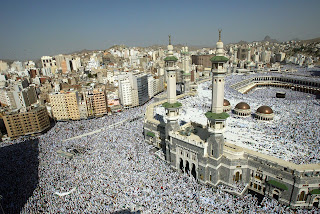
Our society and its busy pace delude us into believing that we have too many things to do and worry about. Life becomes so busy that we tend to forget that as a spiritual being apart from food and drink we also need spiritual nourishment to preserve the integrity and peace of our soul and body.
Allah SWT as our creator knows what we need to feel the peace in our heart. We need to get closer to Him through His worship. So we are getting a great chance to renew and boost our faith as the holy month of Dhul Hijja is going to approach us very soon. Let us do our best to reap as much benefit as possible from this great month.
Usually we as Muslims tend to regard the month of Dhul Hijja as a month exclusively significant for pilgrims as they have to embark upon a great journey to Makkah and perform all the rituals recommended during hajj i.e. staying in Mina, ‘Arafah, Mujdalifa , stoning , sacrificing an animal, doing tawaf and sa’y bewen Safa and Marwa and so on. Although the remaining Muslims around the world celebrate the Eid ul Adha and sacrifice animal, most of the times these are the only action done with lots of enthusiasm.
We tend to forget that this great month has been blessed tremendously by Allah SWT. The first ten days of Dhul Hijjah are regarded as the best days of the year. Allah SWT says in the Qur'ân:
"By the dawn and by the ten nights … " [Al-Qur'ân 89:1-2]
Ibn Kathîr said that "the ten nights" referred to here are the ten days of Dhul-Hijjah, and this opinion was also held by Ibn Abbâs, Ibn az-Zubair, Mujâhid and others.
Moreover, Allah says:
" … and remember the name of Allah in the appointed days." [Al-Qur'ân 2:203]
Ibn Abbâs and Ibn Kathîr said this means in the ten days of Dhul-Hijjah.
If we ponder upon the Sunnah of our beloved prophet Muhammad SAW we can get more evidence on the superiority of the first ten days of Dhul-Hijjah.
Ibn `Abbas (may Allah be pleased with him and his father) reported that the Prophet (peace and blessings be upon him) said: “There are no days in which righteous deeds are more beloved to Allah than these ten days.” The people asked, “Not even Jihad for the sake of Allah?” He said, “Not even Jihad for the sake of Allah, except in the case of a man who went out, giving himself and his wealth up for the cause (of Allah), and came back with nothing.” (Reported by Al-Bukhari)
`Abdullah ibn `Umar (may Allah be pleased with him and his father) reported that the Prophet (peace and blessings be upon him) said: “There are no days greater in the sight of Allah and in which righteous deeds are more beloved to Him than these ten days, so during this time recite a great deal of tahlil [saying: 'there is no god but Allah'], takbir [saying 'God is great'] and tahmid [praising God].” (Reported by Ahmad)
This holy month gives us a great opportunity to strengthen our faith and become better Muslims. Let us prepare ourselves with best of plan to welcome this month with lots of enthusiasm Insha-Allah. Allah SWT is so merciful to us that He SWT through His messenger SAW has also shown us the best of the ways we can worship Him. Therefore let us learn and practice those golden ways to please Allah SWT.
Actions we can perform and hopefully gain Allah SWT’s pleasure Insha-Allah:
Although Hajj and Umrah are the best deeds performed in Dhul-Hijjah here I would like to concentrate on Muslims who are not going for hajj and umrah.
1. Fasting the First Nine Days, Especially the Day of `Arafah (9th of Dhul Hijjah)
It is recommended to fast during the first nine days of Dhu’l Hijja. The tenth day is the day of Eid, and is prohibitively disliked and sinful to fast this day. However, if someone is not able to do the entire nine days of fasting then they should at least try to fast on the day of ‘Arafah which is the ninth day of Dhul Hijjah as it is a sunnah of our beloved prophet SAW.
The Day of `Arafah is regarded as the best day of the whole year.
It has been narrated by Abu Qatada (Allah be pleased with him) that the Messenger of Allah (blessings and peace be upon him, his family, and companions) said, “Fasting the Day of `Arafah [9th of Dhu’l Hijjah ] expiates the [minor] sins of two years: a past one and a coming one.” [Reported by Muslim, Abu Dawud, Nasa’i, and Ibn Majah]
Allah chose fasting for Himself from all the good deeds, as is stated in the Hadeeth Qudsee: “All the deeds of the son of Adam are for him, except for fasting, which is for Me and I am the One Who will reward him for it.” [Saheeh al-Bukharee (1085)]
2. Saying the Takbir as much as possible Insha-Allah:
It is Sunnah to say takbir, tahmid, tahlil, and tasbih during the first ten days of Dhul-Hijjah, and to say it loudly in the mosque, the home, the street and every place where it is permitted to remember Allah SWT and mention His name out loud, as an act of worship and as a proclamation of the greatness of Allah, may He be exalted. Men should recite these phrases out loud, and women should recite them quietly. Allah says: (That they might witness things that are of benefit to them (i.e., reward of Hajj in the Hereafter, and also some worldly gain from trade, etc.), and mention the name of Allah on appointed days, over the beast of cattle that He has provided for them (for sacrifice)... ) (Al-Hajj 22: 28) The majority of scholars agree that the "appointed days" are the first ten days of Dhul-Hijjah, because of the words of ibn `Abbas (may Allah be pleased with him and his father): "The ‘appointed days’ are the first ten days (of Dhul-Hijj ah)."
The takbir should be pronounced loudly by men, in order to revive the Sunnah and as a reminder to the negligent. There is sound evidence that ibn `Umar and Abu Hurayrah (may Allah be pleased with them both) used to go out in the marketplace during the first ten days of Dhul-Hijjah, reciting takbir, and the people would recite it after him. The idea behind reminding the people to recite this is that each one should recite it individually, not in unison, as there is no basis in Shari`ah for doing this.
The transmitted wording of takbir is: “Allahu Akbar, Allahu Akbar, la Ilaha illa Allah; Allahu Akbar, Allahu Akbar, walillah al-hamd” (Allah is the Greatest, Allah is the Greatest. There is no god but Allah; Allah is the Greatest, Allah is the Greatest, and all praise is due to Allah).
According to Sheikh Yusuf Al-Qaradawi, there are two types of takbir in Dhul-Hijjah: unrestricted takbir and restricted takbir. Unrestricted takbir is applicable at any time or place, from the first of Dhul-Hijjah until the days of `Eid. Hence, a man can make takbir in the roads, markets, in Mina, and also when people meet each other. All these are occasions for unrestricted takbir.
Restricted takbir, on the other hand, is restricted to the time following every obligatory prayer, especially if it is offered in congregation, as most scholars restrict it. This type of takbir also includes takbir in the place of `Eid Prayer, on the way to it and while one is sitting around waiting for the `Eid prayer
3. Offering a Sacrifice:
One of the good deeds that will bring a person closer to Allah SWT during these ten days is offering a sacrifice. According to Sheikh M. S. Al-Munajjid, a prominent Saudi Muslim lecturer and author, the one who wants to offer a sacrifice must stop cutting his hair and nails and removing anything from his skin, from the beginning of the ten days until after he has offered his sacrifice, because the Prophet (peace and blessings be upon him) said: "When you see the new moon of Dhul-Hijjah, if any one of you wants to offer a sacrifice, then he should stop cutting his hair and nails until he has offered his sacrifice."
However, if a person does any of these things deliberately, he must seek Allah’s forgiveness but is not required to offer (an extra) sacrifice in expiation. Whoever needs to remove some hair, nails, etc., because it harms him, such as having a broken nail or a wound in a site where there is hair, should do so and there is nothing wrong with that.
4. Studying the Qur’an with meaning and tafseer (explanation):
Through studying the Quran we can seek true knowledge of our faith and strengthen our belief with conviction. Sadly we tend to miss this great chance to educate ourselves with proper knowledge of Islam through mere recitation and not really giving importance to the meaning of this divine book. If we really like to change our poor condition and become better Muslims then only through learning Allah’s message explained in the Qur’an we can achieve our destination. Allah SWT loves the learned Muslims and makes their path to learning easy and blessed. According to sunnah, if Allah SWT wants to do good to a person, He makes him or her comprehend the religion (the understanding of the Qur’an and the Sunnah of our beloved prophet SAW) It has been said that the best among Muslims is the one who learns the Qur’an and teaches it to others.
5. Recitation and memorization of the Qur’an:
We should also try to recite the Quran and try to memorize it to the best of our abilities Insha-Allah. According to the sunnah, every letter of the Quran brings us reward so we should try our best to make the reading as well as following the instructions of this holy book a daily habit Insha-Allah. We can start through the ten days of Dhul Hijjah Insha-Allah.
Narrated by Abu Musa RAW, the prophet SAW said, “The example of a believer who recites the Qur’an and acts on it, is like a citron which tastes nice and smells nice. And the example of a believer who does not recite the Qur’an but acts on it is like a date which tastes good but has no smell. And the example of a hypocrite who recites the Qur’an is like a Raihana (sweet basil) which smells good but tastes bitter. And the example of a hypocrite who does not recite the Qur’an is like a colocynth which tastes bitter and has a bad smell.” [6:579- O.B Al-Bukhari]
6. Being kind and dutiful to our parents and relatives:
Allah SWT has ordered us to be good to our parents and do our best to please them as long as they do not tell us to be disobedient to Allah SWT. Our parent’s satisfaction in us is very crucial for us as without their blessing we cannot achieve closeness of Allah SWT in our life. Moreover, being nice to our relatives and helping them whenever they need us are also recommended by Allah SWT quite strongly. So let us be nice and helpful to our parents and relatives and in return earn the blessings of Allah SWT, insha-Allah.
7. Performing plenty of voluntary prayers during the days and nights of Dhul Hijjah:
In addition to the five daily prayers, there are different types of voluntary prayers. Voluntary prayers are recommended by our beloved prophet SAW as these sorts of prayers bring us closer to Allah SWT. We can pray the Salatut Tawbah, Salatut Tasbeeh, Salat al-Israq, Salat at-Duha, Salat al-Awwabin , Salat at-Tahajjud and so on.
8. Making lots of tawbah (repentance):
We should make sincere tawbah (Repentance) to Allah SWT as repentance means coming back to Allah SWT. When a Muslim combines repentance with good deeds during the most virtuous days, this is a sign of his success. Allah says: “But as for him who repented, believed and did righteous deeds, then he will be among those who are successful.” [Soorah al-Qasas (28): 67]
I would like to share with you a wonderful dua for repentance. Narrated by Shaddad Bin Aus RAW, the prophet SAW said, “The most superior way of asking for forgiveness from Allah SWT is:
Allahumma anta Rabbi , la ilaaha illa anta. Anta khalaqtani wa ana ‘abduka , wa ana ’ala ‘ahdikaa wa wa’dika mastata’tu. A’udhu bika min sharri ma sana’tu, abuu laka bini’matika ‘alaiya, wa abuu laka bidhanbi faghfirli fa innahu la yaghfiru adhdhunuba illa Anta.” which means
“O Allah, You are my Lord! None has the right to be worshipped but You. You created me and I am Your slave and I am faithful to my covenant and my promise (to You) as much as I can. I seek refuge with You from all the evil I have done. I acknowledge before You all the blessings You have bestowed upon me, and I confess to You all my sins. So I entreat You to forgive my sins, for nobody can forgive sins except You.”
The prophet SAW added: “If somebody recites it during the day with firm faith in it and dies on the same day before the evening, he will be from the people of Jannah; and if somebody recites it at night with firm faith in it and dies before the morning, he will be from the people of jannah.” ( Sahih Al-Bukhari, vol.8 hadith no.318)
9. Giving Charity (Sadaqah):
Charity is central to a Muslim's life. Allah SWT loves the act of charity. Even smiling to our fellow Muslims is regarded as a charity. Helping the needy and poor people around the world can strengthen our faith and Insha-Allah will make us better Muslims. The Qur'an encourages the Muslim to donate their money: “The likeness of those who spend their wealth in the way of Allah, is as the likeness of a grain that sprouts seven spikes. In every spike there are hundred grains, and Allah multiplies for whom He will' (2:261). Giving charity is thereby not seen as detracting from income, but rather as a multiplication in terms of spiritual observance. It is like one who sows a good grain of wheat in the field from which grows a plant on which sprout seven ears and each ear yields hundred grains. As a result, one grain was worth a total yield of 700 grains. When one spends in the way of Allah, he or she receives in return (reward in the Hereafter) on the scale of one to seven hundred. Subahanallah!
10. Attending the Salaat al-Eid and the Khutbah:
The tenth of Dhul-Hijjah is `Eid Al-Adha or the day of An-Nahr (slaughtering). It marks the conclusion of the major rites of Hajj, and commemorates Allah’s bounty on His Messenger Ibrahim AS when He gave him a ram to sacrifice as ransom for his son Isma`il, peace and blessing be upon him.
"The day of Al-Fitr [i.e. `Eid Al-Fitr], the day of An-Nahr, and the days of Tashriq are `Eid days for us Muslims. They are days of eating and drinking." [Ahmad, An-Nasa’i, Sahih Al-Jami` #8192]
The three days following `Eid Al-Adha, while the pilgrims complete their rites, Muslims continue with their `Eid celebrations, and are prohibited to fast. "The days of Tashriq are days of eating, drinking and mentioning Allah." [Muslim]
Attending the Salaat al-Eid and the Khutbah are recommended not just for men. The Muslim women should try to perform the prayer too as it has been stressed by our beloved prophet SAW. For the sake of unity and celebrating this great day, He SAW even asked the menstruating women to come to the mosque but of course keep a distance from the actual prayer area.
Therefore, we can perform lots of righteous deed during the first ten days of Dhul Hijjah. It is better to write our plan in a diary and try to get enough preparation in order to welcome the great month of Dhul Hijjah and get the blessings of Allah SWT. Our ultimate goal is to please our Lord Allah SWT. May Allah give us success in these blessed days and nights, and in every moment of our lives, to follow the path of the Prophet (Allah SWT bless him & give him peace), and may He make us of those whom He loves and who love Him.

Our society and its busy pace delude us into believing that we have too many things to do and worry about. Life becomes so busy that we tend to forget that as a spiritual being apart from food and drink we also need spiritual nourishment to preserve the integrity and peace of our soul and body.
Allah SWT as our creator knows what we need to feel the peace in our heart. We need to get closer to Him through His worship. So we are getting a great chance to renew and boost our faith as the holy month of Dhul Hijja is going to approach us very soon. Let us do our best to reap as much benefit as possible from this great month.
Usually we as Muslims tend to regard the month of Dhul Hijja as a month exclusively significant for pilgrims as they have to embark upon a great journey to Makkah and perform all the rituals recommended during hajj i.e. staying in Mina, ‘Arafah, Mujdalifa , stoning , sacrificing an animal, doing tawaf and sa’y bewen Safa and Marwa and so on. Although the remaining Muslims around the world celebrate the Eid ul Adha and sacrifice animal, most of the times these are the only action done with lots of enthusiasm.
We tend to forget that this great month has been blessed tremendously by Allah SWT. The first ten days of Dhul Hijjah are regarded as the best days of the year. Allah SWT says in the Qur'ân:
"By the dawn and by the ten nights … " [Al-Qur'ân 89:1-2]
Ibn Kathîr said that "the ten nights" referred to here are the ten days of Dhul-Hijjah, and this opinion was also held by Ibn Abbâs, Ibn az-Zubair, Mujâhid and others.
Moreover, Allah says:
" … and remember the name of Allah in the appointed days." [Al-Qur'ân 2:203]
Ibn Abbâs and Ibn Kathîr said this means in the ten days of Dhul-Hijjah.
If we ponder upon the Sunnah of our beloved prophet Muhammad SAW we can get more evidence on the superiority of the first ten days of Dhul-Hijjah.
Ibn `Abbas (may Allah be pleased with him and his father) reported that the Prophet (peace and blessings be upon him) said: “There are no days in which righteous deeds are more beloved to Allah than these ten days.” The people asked, “Not even Jihad for the sake of Allah?” He said, “Not even Jihad for the sake of Allah, except in the case of a man who went out, giving himself and his wealth up for the cause (of Allah), and came back with nothing.” (Reported by Al-Bukhari)
`Abdullah ibn `Umar (may Allah be pleased with him and his father) reported that the Prophet (peace and blessings be upon him) said: “There are no days greater in the sight of Allah and in which righteous deeds are more beloved to Him than these ten days, so during this time recite a great deal of tahlil [saying: 'there is no god but Allah'], takbir [saying 'God is great'] and tahmid [praising God].” (Reported by Ahmad)
This holy month gives us a great opportunity to strengthen our faith and become better Muslims. Let us prepare ourselves with best of plan to welcome this month with lots of enthusiasm Insha-Allah. Allah SWT is so merciful to us that He SWT through His messenger SAW has also shown us the best of the ways we can worship Him. Therefore let us learn and practice those golden ways to please Allah SWT.
Actions we can perform and hopefully gain Allah SWT’s pleasure Insha-Allah:
Although Hajj and Umrah are the best deeds performed in Dhul-Hijjah here I would like to concentrate on Muslims who are not going for hajj and umrah.
1. Fasting the First Nine Days, Especially the Day of `Arafah (9th of Dhul Hijjah)
It is recommended to fast during the first nine days of Dhu’l Hijja. The tenth day is the day of Eid, and is prohibitively disliked and sinful to fast this day. However, if someone is not able to do the entire nine days of fasting then they should at least try to fast on the day of ‘Arafah which is the ninth day of Dhul Hijjah as it is a sunnah of our beloved prophet SAW.
The Day of `Arafah is regarded as the best day of the whole year.
It has been narrated by Abu Qatada (Allah be pleased with him) that the Messenger of Allah (blessings and peace be upon him, his family, and companions) said, “Fasting the Day of `Arafah [9th of Dhu’l Hijjah ] expiates the [minor] sins of two years: a past one and a coming one.” [Reported by Muslim, Abu Dawud, Nasa’i, and Ibn Majah]
Allah chose fasting for Himself from all the good deeds, as is stated in the Hadeeth Qudsee: “All the deeds of the son of Adam are for him, except for fasting, which is for Me and I am the One Who will reward him for it.” [Saheeh al-Bukharee (1085)]
2. Saying the Takbir as much as possible Insha-Allah:
It is Sunnah to say takbir, tahmid, tahlil, and tasbih during the first ten days of Dhul-Hijjah, and to say it loudly in the mosque, the home, the street and every place where it is permitted to remember Allah SWT and mention His name out loud, as an act of worship and as a proclamation of the greatness of Allah, may He be exalted. Men should recite these phrases out loud, and women should recite them quietly. Allah says: (That they might witness things that are of benefit to them (i.e., reward of Hajj in the Hereafter, and also some worldly gain from trade, etc.), and mention the name of Allah on appointed days, over the beast of cattle that He has provided for them (for sacrifice)... ) (Al-Hajj 22: 28) The majority of scholars agree that the "appointed days" are the first ten days of Dhul-Hijjah, because of the words of ibn `Abbas (may Allah be pleased with him and his father): "The ‘appointed days’ are the first ten days (of Dhul-Hijj ah)."
The takbir should be pronounced loudly by men, in order to revive the Sunnah and as a reminder to the negligent. There is sound evidence that ibn `Umar and Abu Hurayrah (may Allah be pleased with them both) used to go out in the marketplace during the first ten days of Dhul-Hijjah, reciting takbir, and the people would recite it after him. The idea behind reminding the people to recite this is that each one should recite it individually, not in unison, as there is no basis in Shari`ah for doing this.
The transmitted wording of takbir is: “Allahu Akbar, Allahu Akbar, la Ilaha illa Allah; Allahu Akbar, Allahu Akbar, walillah al-hamd” (Allah is the Greatest, Allah is the Greatest. There is no god but Allah; Allah is the Greatest, Allah is the Greatest, and all praise is due to Allah).
According to Sheikh Yusuf Al-Qaradawi, there are two types of takbir in Dhul-Hijjah: unrestricted takbir and restricted takbir. Unrestricted takbir is applicable at any time or place, from the first of Dhul-Hijjah until the days of `Eid. Hence, a man can make takbir in the roads, markets, in Mina, and also when people meet each other. All these are occasions for unrestricted takbir.
Restricted takbir, on the other hand, is restricted to the time following every obligatory prayer, especially if it is offered in congregation, as most scholars restrict it. This type of takbir also includes takbir in the place of `Eid Prayer, on the way to it and while one is sitting around waiting for the `Eid prayer
3. Offering a Sacrifice:
One of the good deeds that will bring a person closer to Allah SWT during these ten days is offering a sacrifice. According to Sheikh M. S. Al-Munajjid, a prominent Saudi Muslim lecturer and author, the one who wants to offer a sacrifice must stop cutting his hair and nails and removing anything from his skin, from the beginning of the ten days until after he has offered his sacrifice, because the Prophet (peace and blessings be upon him) said: "When you see the new moon of Dhul-Hijjah, if any one of you wants to offer a sacrifice, then he should stop cutting his hair and nails until he has offered his sacrifice."
However, if a person does any of these things deliberately, he must seek Allah’s forgiveness but is not required to offer (an extra) sacrifice in expiation. Whoever needs to remove some hair, nails, etc., because it harms him, such as having a broken nail or a wound in a site where there is hair, should do so and there is nothing wrong with that.
4. Studying the Qur’an with meaning and tafseer (explanation):
Through studying the Quran we can seek true knowledge of our faith and strengthen our belief with conviction. Sadly we tend to miss this great chance to educate ourselves with proper knowledge of Islam through mere recitation and not really giving importance to the meaning of this divine book. If we really like to change our poor condition and become better Muslims then only through learning Allah’s message explained in the Qur’an we can achieve our destination. Allah SWT loves the learned Muslims and makes their path to learning easy and blessed. According to sunnah, if Allah SWT wants to do good to a person, He makes him or her comprehend the religion (the understanding of the Qur’an and the Sunnah of our beloved prophet SAW) It has been said that the best among Muslims is the one who learns the Qur’an and teaches it to others.
5. Recitation and memorization of the Qur’an:
We should also try to recite the Quran and try to memorize it to the best of our abilities Insha-Allah. According to the sunnah, every letter of the Quran brings us reward so we should try our best to make the reading as well as following the instructions of this holy book a daily habit Insha-Allah. We can start through the ten days of Dhul Hijjah Insha-Allah.
Narrated by Abu Musa RAW, the prophet SAW said, “The example of a believer who recites the Qur’an and acts on it, is like a citron which tastes nice and smells nice. And the example of a believer who does not recite the Qur’an but acts on it is like a date which tastes good but has no smell. And the example of a hypocrite who recites the Qur’an is like a Raihana (sweet basil) which smells good but tastes bitter. And the example of a hypocrite who does not recite the Qur’an is like a colocynth which tastes bitter and has a bad smell.” [6:579- O.B Al-Bukhari]
6. Being kind and dutiful to our parents and relatives:
Allah SWT has ordered us to be good to our parents and do our best to please them as long as they do not tell us to be disobedient to Allah SWT. Our parent’s satisfaction in us is very crucial for us as without their blessing we cannot achieve closeness of Allah SWT in our life. Moreover, being nice to our relatives and helping them whenever they need us are also recommended by Allah SWT quite strongly. So let us be nice and helpful to our parents and relatives and in return earn the blessings of Allah SWT, insha-Allah.
7. Performing plenty of voluntary prayers during the days and nights of Dhul Hijjah:
In addition to the five daily prayers, there are different types of voluntary prayers. Voluntary prayers are recommended by our beloved prophet SAW as these sorts of prayers bring us closer to Allah SWT. We can pray the Salatut Tawbah, Salatut Tasbeeh, Salat al-Israq, Salat at-Duha, Salat al-Awwabin , Salat at-Tahajjud and so on.
8. Making lots of tawbah (repentance):
We should make sincere tawbah (Repentance) to Allah SWT as repentance means coming back to Allah SWT. When a Muslim combines repentance with good deeds during the most virtuous days, this is a sign of his success. Allah says: “But as for him who repented, believed and did righteous deeds, then he will be among those who are successful.” [Soorah al-Qasas (28): 67]
I would like to share with you a wonderful dua for repentance. Narrated by Shaddad Bin Aus RAW, the prophet SAW said, “The most superior way of asking for forgiveness from Allah SWT is:
Allahumma anta Rabbi , la ilaaha illa anta. Anta khalaqtani wa ana ‘abduka , wa ana ’ala ‘ahdikaa wa wa’dika mastata’tu. A’udhu bika min sharri ma sana’tu, abuu laka bini’matika ‘alaiya, wa abuu laka bidhanbi faghfirli fa innahu la yaghfiru adhdhunuba illa Anta.” which means
“O Allah, You are my Lord! None has the right to be worshipped but You. You created me and I am Your slave and I am faithful to my covenant and my promise (to You) as much as I can. I seek refuge with You from all the evil I have done. I acknowledge before You all the blessings You have bestowed upon me, and I confess to You all my sins. So I entreat You to forgive my sins, for nobody can forgive sins except You.”
The prophet SAW added: “If somebody recites it during the day with firm faith in it and dies on the same day before the evening, he will be from the people of Jannah; and if somebody recites it at night with firm faith in it and dies before the morning, he will be from the people of jannah.” ( Sahih Al-Bukhari, vol.8 hadith no.318)
9. Giving Charity (Sadaqah):
Charity is central to a Muslim's life. Allah SWT loves the act of charity. Even smiling to our fellow Muslims is regarded as a charity. Helping the needy and poor people around the world can strengthen our faith and Insha-Allah will make us better Muslims. The Qur'an encourages the Muslim to donate their money: “The likeness of those who spend their wealth in the way of Allah, is as the likeness of a grain that sprouts seven spikes. In every spike there are hundred grains, and Allah multiplies for whom He will' (2:261). Giving charity is thereby not seen as detracting from income, but rather as a multiplication in terms of spiritual observance. It is like one who sows a good grain of wheat in the field from which grows a plant on which sprout seven ears and each ear yields hundred grains. As a result, one grain was worth a total yield of 700 grains. When one spends in the way of Allah, he or she receives in return (reward in the Hereafter) on the scale of one to seven hundred. Subahanallah!
10. Attending the Salaat al-Eid and the Khutbah:
The tenth of Dhul-Hijjah is `Eid Al-Adha or the day of An-Nahr (slaughtering). It marks the conclusion of the major rites of Hajj, and commemorates Allah’s bounty on His Messenger Ibrahim AS when He gave him a ram to sacrifice as ransom for his son Isma`il, peace and blessing be upon him.
"The day of Al-Fitr [i.e. `Eid Al-Fitr], the day of An-Nahr, and the days of Tashriq are `Eid days for us Muslims. They are days of eating and drinking." [Ahmad, An-Nasa’i, Sahih Al-Jami` #8192]
The three days following `Eid Al-Adha, while the pilgrims complete their rites, Muslims continue with their `Eid celebrations, and are prohibited to fast. "The days of Tashriq are days of eating, drinking and mentioning Allah." [Muslim]
Attending the Salaat al-Eid and the Khutbah are recommended not just for men. The Muslim women should try to perform the prayer too as it has been stressed by our beloved prophet SAW. For the sake of unity and celebrating this great day, He SAW even asked the menstruating women to come to the mosque but of course keep a distance from the actual prayer area.
Therefore, we can perform lots of righteous deed during the first ten days of Dhul Hijjah. It is better to write our plan in a diary and try to get enough preparation in order to welcome the great month of Dhul Hijjah and get the blessings of Allah SWT. Our ultimate goal is to please our Lord Allah SWT. May Allah give us success in these blessed days and nights, and in every moment of our lives, to follow the path of the Prophet (Allah SWT bless him & give him peace), and may He make us of those whom He loves and who love Him.
Tuesday, 20 October 2009
A quick flan case dessert

Cheesecake recipe

Subscribe to:
Posts (Atom)